
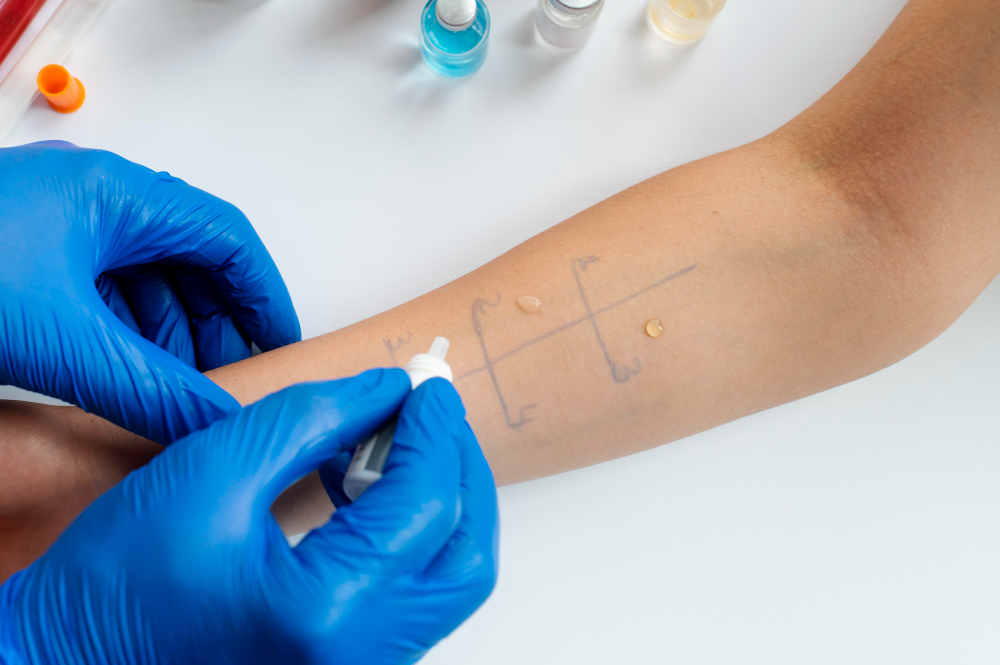
Patch testing is the gold standard diagnostic tool for identifying contact allergens—substances that trigger an allergic skin reaction (contact dermatitis) upon direct contact. Unlike the skin prick test used for environmental or food allergies, patch testing is specifically designed to detect delayed hypersensitivity reactions, which can take 48–72 hours to develop.
Small amounts of common and occupation-specific allergens are applied to adhesive panels and placed on your back, where they remain for 48 hours. You will return to our office for readings at 48 hours and again at 72–96 hours to assess your skin’s reactions.
We use the North American Standard Series, which includes a comprehensive list of 80 allergens. Custom panels can also be ordered if needed.
Who Should Consider Patch Testing?
Patch testing may be right for you if you experience:
- A recurring or chronic rash that flares in areas of skin contact
- Suspected reactions to jewelry, watches, or belt buckles (nickel allergy)
- Skin reactions to skincare products, cosmetics, or hair dye
- Occupational skin reactions (healthcare workers, hairdressers)
- Eczema that is not well controlled despite standard treatment
- Unexplained facial and hand dermatitis
What to Expect During Patch Testing
The process spans three visits over approximately one week:
- Visit 1 – Application: Allergen panels are applied to your upper back and secured with medical tape.
- Visit 2 (48 hours later) – First Reading: Panels are removed and your skin is assessed for reactions.
- Visit 3 (72–96 hours after application) – Final Reading: A second assessment captures delayed reactions. Results are reviewed with you in detail.
During the testing period, you should keep your back dry, avoid heavy sweating, and refrain from scratching. You may continue most normal activities and can take oral antihistamines for itching if needed.
Interpreting Your Results
Our physicians review your patch test results in the context of your full history—what products you use, your occupation, and your hobbies—to determine which positive reactions are clinically relevant. You will receive a personalized list of substances to avoid and guidance on finding safe alternative products via the American Contact Dermatitis Society app.
Ready to Schedule?
Call us at (408) 286-1707 or request an appointment online. Offices in San Jose, Los Gatos, Mountain View, and Redwood City.
Frequently Asked Questions
Is patch testing the same as a skin prick test?
No. A skin prick test detects IgE-mediated (immediate Type I) allergies to pollens, pet dander, foods, and other environmental triggers. Patch testing detects delayed (Type IV) contact allergies. Many patients benefit from both tests.
Does patch testing hurt?
Patch testing is generally well tolerated. You may feel mild itching if a reaction occurs—this is expected and actually part of what we are looking for.
Will I need to stop any medications?
Certain medications, particularly systemic corticosteroids and immunosuppressants, can suppress patch test reactions and may need to be paused. Our team will review your current medications at scheduling and advise you individually. Please do not stop any medications without consulting your physician.