
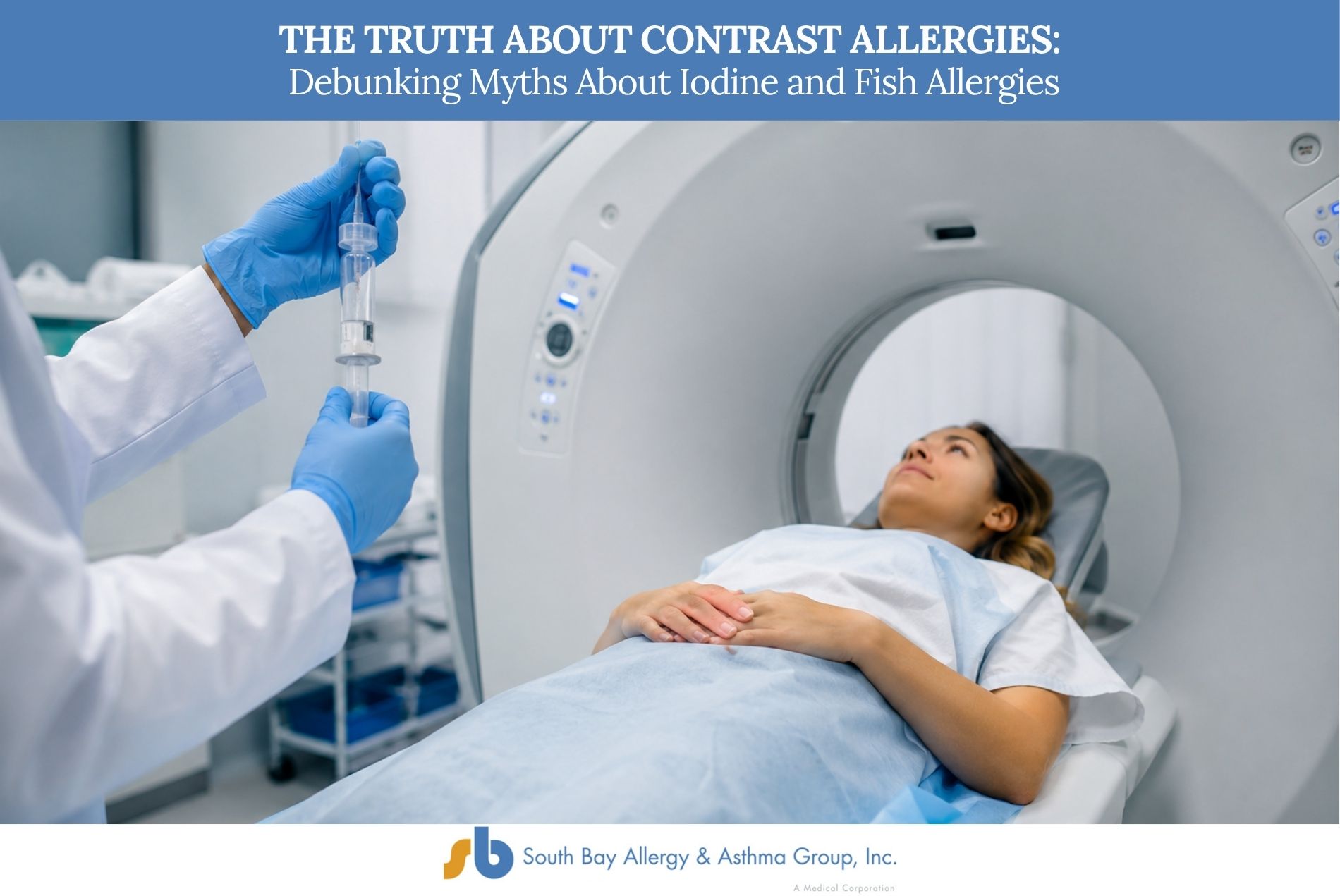
Medical imaging tests such as CT scans, angiograms, and certain X-rays often use contrast dye to help physicians see organs, blood vessels, and tissues more clearly. However, many patients become concerned when they hear terms like “contrast allergy,” especially if they have a history of seafood or iodine allergies. One of the most common misconceptions in allergy medicine is the belief that a fish or shellfish allergy automatically means a person is allergic to contrast dye.
At South Bay Allergy and Asthma Group, our board-certified allergy and asthma specialists help patients separate myths from medical facts so they can receive safe, effective care with confidence.
In this article, we’ll explain the truth about contrast allergies, the role of iodine, the connection to fish and shellfish allergies, symptoms to watch for, and when allergy evaluation may be appropriate.
What Is Contrast Dye?
Contrast dye, also called contrast media, is a substance used during imaging studies to improve the visibility of internal structures. Contrast agents are commonly used in:
- CT scans
- Angiograms
- Cardiac catheterization procedures
- MRI scans
- Certain X-rays
The most commonly discussed contrast agents are iodinated contrast media, which contain iodine and are used in CT scans and vascular imaging.
Myth #1: “I’m Allergic to Iodine”
One of the biggest myths in medicine is the concept of being “allergic to iodine.”
The Truth:
Iodine itself is not an allergen.
Iodine is a naturally occurring element that is essential for human life and thyroid function. The body actually requires iodine to produce thyroid hormones.
Because iodine is found naturally in the body and in many foods, people cannot truly be allergic to iodine itself.
When patients react to iodinated contrast dye, the reaction is caused by other properties of the contrast agent — not the iodine.
Myth #2: Fish or Shellfish Allergies Mean You’ll React to Contrast Dye
This is another widespread misconception.
The Truth:
Having a fish or shellfish allergy does not increase your risk of having an allergic reaction to iodinated contrast dye.
Shellfish allergies are caused by proteins such as tropomyosin, not iodine. Fish allergies are also triggered by specific proteins within fish tissue.
There is no cross-reactivity between seafood allergies and contrast dye allergies.
According to major medical organizations, including the American College of Radiology, patients with seafood allergies are not at higher risk for contrast reactions compared to people with other food allergies.
What Causes Contrast Reactions?
Some people may experience reactions to contrast media, but these reactions are generally related to the chemical properties of the contrast agent itself.
Possible reactions include:
- Mild itching
- Hives
- Flushing
- Nausea
- Sneezing
- Swelling
- Shortness of breath
- Low blood pressure (rare)
- Severe allergic-like reactions (very rare)
Most reactions are mild and temporary.
Who Is Actually at Higher Risk for Contrast Reactions?
You may have an increased risk of a contrast reaction if you:
- Previously had a reaction to contrast dye
- Have severe asthma
- Have multiple severe allergies
- Have certain mast cell disorders
A prior reaction to contrast is the strongest predictor of a future reaction.
Are Contrast Reactions True Allergies?
Not always.
Many contrast reactions are considered allergic-like reactions rather than true IgE-mediated allergies. This means the immune system may not behave the same way it does in classic food allergies.
However, in some cases, true allergic mechanisms can occur.
An allergist can help determine:
- Whether a prior reaction was likely allergic
- Your future risk
- Whether testing or premedication is recommended
Can You Still Get Imaging With Contrast If You Had a Prior Reaction?
Often, yes.
Depending on the severity of the previous reaction, physicians may recommend:
- Using a different contrast agent
- Premedication with antihistamines or steroids
- Allergy consultation
- Careful monitoring during imaging
Modern contrast agents now are generally much safer and better tolerated than older formulations.
The Importance of Accurate Allergy Documentation
Incorrectly labeling someone as “iodine allergic” can create unnecessary anxiety and may delay important medical tests or procedures.
That’s why it’s essential to work with an experienced allergy specialist who can properly evaluate:
- Prior reactions
- Medication concerns
- Imaging risks
- True allergy status
At South Bay Allergy and Asthma Group, we help patients receive accurate diagnoses and evidence-based guidance.
Frequently Asked Questions (Q&A)
Can I have a CT scan if I’m allergic to shellfish?
Yes. A shellfish allergy does not mean you are allergic to CT contrast dye. The proteins that cause shellfish allergies are unrelated to iodine or contrast media.
Is iodine allergy real?
No. Iodine itself is not an allergen and is essential for human health. People may react to substances containing iodine, but not to iodine itself.
What should I do if I had a previous reaction to contrast dye?
Inform your physician and radiology team about the reaction details. An allergist can evaluate your risk and help determine whether premedication or alternative imaging strategies are needed.
Are MRI contrast agents the same as CT contrast agents?
No. MRI contrast agents usually contain gadolinium, while CT contrast agents are iodinated contrast media. Reactions to one do not necessarily mean you will react to the other.
What are the symptoms of a contrast reaction?
Symptoms can include:
- Itching
- Hives
- Rash
- Swelling
- Wheezing
- Nausea
- Flushing
- Dizziness
Severe reactions are rare but require immediate medical attention.
Should I avoid seafood before a CT scan with contrast?
No. Seafood consumption has no connection to contrast reactions.
Can allergy testing determine if I’ll react to contrast dye?
In certain situations, allergy specialists may perform evaluation or testing, especially after prior reactions. Testing may help guide future imaging recommendations.
Is contrast dye safe for most people?
Yes. Modern contrast agents are considered safe for the vast majority of patients. Serious reactions are uncommon.
When should I see an allergist about contrast concerns?
You should consider allergy evaluation if you:
- Had a prior contrast reaction
- Have severe asthma and multiple allergies
- Are uncertain whether your prior reaction was truly allergic
Trust South Bay Allergy and Asthma Group for Expert Allergy Care
At South Bay Allergy and Asthma Group, our experienced allergy and asthma specialists provide comprehensive evaluations for food allergies, medication allergies, asthma, sinus conditions, eczema, hives, and allergic reactions.
We are committed to helping patients receive accurate diagnoses while avoiding unnecessary restrictions or medical misconceptions.
If you have questions about contrast dye reactions, food allergies, or asthma management, our team is here to help.
Contact South Bay Allergy and Asthma Group
San Jose Office
South Bay Allergy and Asthma Group
2211 Moorpark Avenue, Suite 130
San Jose, CA 95128
📞 Phone: (408) 286-1707
Los Gatos Office
South Bay Allergy and Asthma Group
14981 National Ave #3
Los Gatos, CA 95124
📞 Phone: (408) 358-1771
📞 Allergy Shot Station: 408-610-2647
Mountain View Office
South Bay Allergy and Asthma Group
2490 Hospital Drive, #209
Mountain View, CA 94040
📞 Phone: (650) 966-8201
📞 Allergy Shot Station: 650-938-6957
Redwood City Office
South Bay Allergy and Asthma Group
100 Arch St Suite 2
Redwood City, CA 94062
📞 Phone: (650) 362-4643
📞 Allergy Shot Station: 650-503-8796
🌐 Website: sballergy.com
📅 Book An Appointment: https://sballergy.com/appointments/